Key Architectural Takeaways
1. London Digital Ecosystem & Enterprise Web Demands
London commands an unrivaled position within the global economy, where institutional banking leaders in the City operate alongside agile technology scaleups across Shoreditch. Enterprise web infrastructure across the capital must sustain heavy computational loads, handle millions of real-time transactions, and satisfy uncompromising performance standards. Outdated monolithic platforms introduce critical latency bottlenecks that degrade corporate revenue, lower brand authority, and elevate operational support costs for demanding organizations.
DesignNCode constructs bespoke web applications engineered specifically for London enterprises seeking durable competitive separation. By pairing advanced Next.js 16 server-side architectures with resilient cloud infrastructure, our engineering teams build high-throughput digital platforms that integrate effortlessly with enterprise databases and financial APIs. We eliminate technical debt and streamline user workflows, ensuring corporate portals achieve remarkable operational velocity. Discover our specialized web development services today.
2. High-Performance Architecture: Next.js 16, React Server Components & Edge Infrastructure
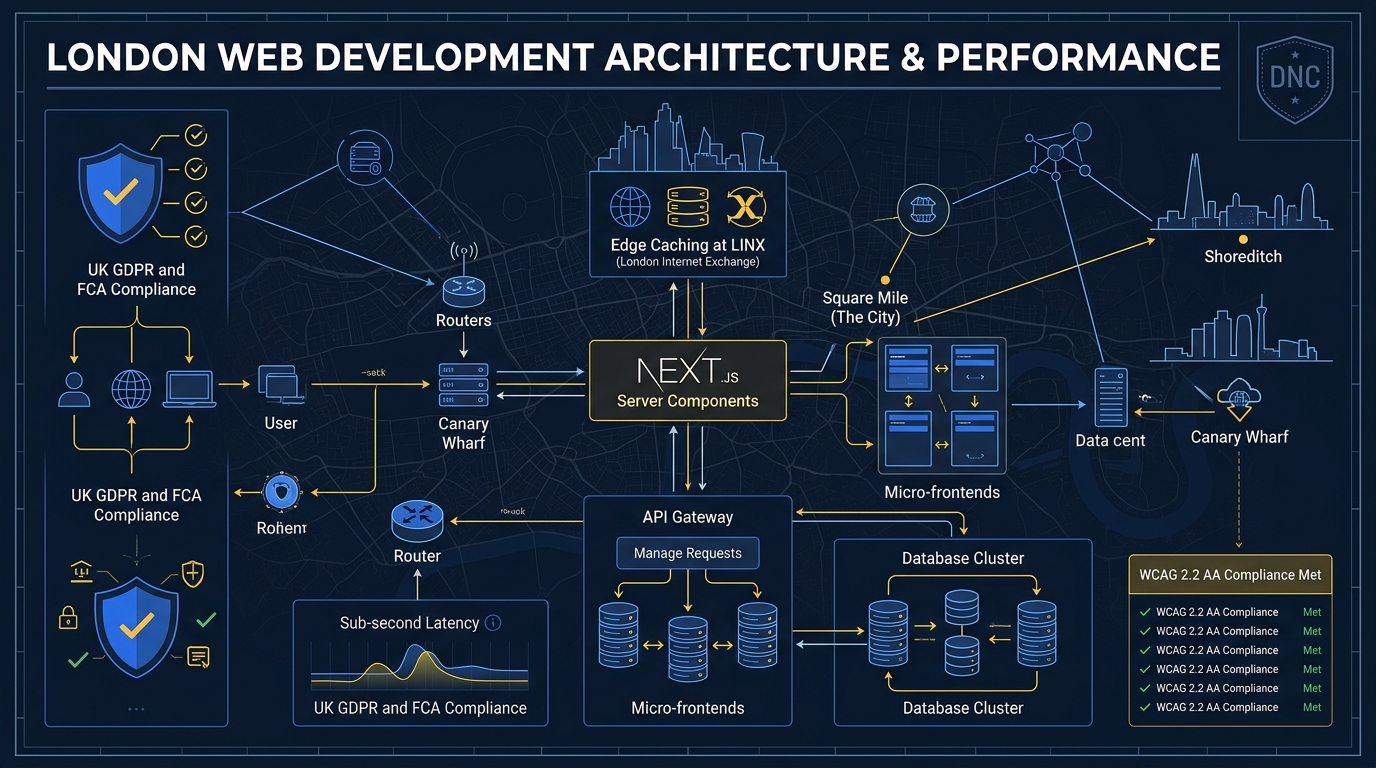
Modern enterprise web platforms in London require frontend architectures that eliminate client-side JavaScript bloat while maintaining dynamic functionality. Leveraging the Next.js App Router and React Server Components, our team moves heavy computational rendering from user devices directly to distributed edge networks. This architectural separation ensures instantaneous initial page loads, reduces Time to First Byte, and eradicates layout shifts, delivering responsive interfaces to corporate users on all devices.
We deploy production web assets directly to localized edge caches at carrier-neutral facilities including Telehouse North in Docklands and the London Internet Exchange (LINX). By routing traffic through high-capacity metropolitan fiber rings and utilizing optimized compression protocols, we ensure static and dynamic payloads resolve with minimal latency. Our practices adhere to official Next.js Documentation standards, empowering London organizations to achieve perfect Core Web Vitals scores.
3. Fintech Reliability, FCA Compliance & Zero-Trust Security Protocols
London represents Europe's primary fintech capital, where financial institutions across Canary Wharf, Mayfair, and Bank require web applications engineered with zero-trust security parameters. Financial software platforms cannot tolerate runtime exceptions, vulnerable dependencies, or ambiguous transactional states. User authentication routines, multi-factor authorization handshakes, and ledger transaction flows must execute deterministically under peak trading conditions. Frontend interfaces must safeguard sensitive records against cross-site scripting vulnerabilities and automated bot networks.
Our full-stack engineering team aligns every deployment with statutory standards enforced by the Financial Conduct Authority (FCA) under Consumer Duty guidelines. We engineer deterministic transactional forms, transparent data disclosures, and tamper-proof audit trails. All data persistence mechanisms, session cookies, and encrypted communications strictly follow UK Information Commissioner's Office (ICO) governance frameworks. London financial enterprises rely on our hardened infrastructure to protect intellectual property, ensure data sovereignty, and pass compliance audits.
| Architecture / Capability | Legacy / Template Monolith | DesignNCode Modern Engineering |
|---|---|---|
| Core Web Vitals & Edge Latency | Bloated JavaScript bundles with slow server response times and high layout shifts | Server components and LINX edge caching delivering sub-100ms loads and zero CLS |
| Regulatory & Security Governance | Vulnerable third-party plugins with inadequate GDPR and FCA audit trails | Zero-trust authentication, deterministic forms, and full UK compliance audits |
| Scalability & Cloud Architecture | Brittle monolithic servers that crash during concurrent traffic spikes | Modular micro-frontends and auto-scaling multi-region Kubernetes clusters |
| Accessibility & Inclusivity | Surface-level styling patches failing modern UK Equality Act standards | Native WCAG 2.2 AA compliant markup and verified screen reader trees |
4. Scaleup Engineering Velocity & Micro-Frontend Modular Systems
High-growth software companies and venture-backed scaleups across Shoreditch, Clerkenwell, and King's Cross Knowledge Quarter face constant pressure to release features rapidly while expanding engineering headcount. When multiple autonomous product squads commit changes to a single monolithic codebase, deployment conflicts multiply, test suites slow down, and agility stalls. Scaling modern web platforms requires modular frontend architectures that allow distributed product teams to build, test, and deploy domain-specific features independently without compromising stability.
DesignNCode architects scalable micro-frontend ecosystems and composable component libraries that decouple complex web platforms into maintainable business domains. By standardizing shared TypeScript interfaces, automated CI/CD deployment pipelines, and centralized UI tokens, we enable London development teams to accelerate sprint cycles and eliminate regression risks. Our clean architectural boundaries allow engineering leaders to scale operations smoothly and integrate innovative microservices. Explore our featured projects to examine our modular frameworks.
Web Development Architecture & Delivery Matrix: London
5. Luxury E-Commerce Architecture & Bespoke Mayfair Storefronts
High-end luxury brands, bespoke couture ateliers, and premier art galleries along Mayfair, Bond Street, and Sloane Street demand digital shopping experiences that convey physical grandeur and exclusivity. Standard commercial e-commerce templates dilute brand prestige through rigid layouts, sluggish image galleries, and disjointed checkout flows. Discerning international buyers expect fluid visual transitions, high-resolution product storytelling, and frictionless transactional privacy. High-ticket digital retail requires bespoke digital craftsmanship that elevates brand equity while delivering rapid load times worldwide.
We architect headless luxury e-commerce platforms that fuse our bespoke UI/UX design services with scalable Shopify and e-commerce development engines. By decoupling the presentation layer from backend inventory databases via GraphQL APIs, we construct fluid product customizers, private salon booking portals, and localized currency checkouts. Our hardware-accelerated image delivery and edge optimization ensure media-rich product showcases render smoothly, enabling London luxury houses to cultivate customer trust and increase average order values.
6. Accessibility Governance & Equality Act WCAG 2.2 Standards
Digital inclusivity is an essential architectural requirement and a mandatory legal obligation under the UK Equality Act 2010. Modern enterprise web applications must provide equal access to all individuals, regardless of visual, motor, auditory, or cognitive differences. Relying on superficial accessibility overlay scripts or post-launch patches exposes commercial enterprises to legal liabilities and brand reputational damage. Digital platforms must incorporate accessible markup, semantic document structures, logical tab navigation orders, and clear ARIA roles directly within source code.
DesignNCode embeds digital accessibility into every phase of software development, engineering web platforms that strictly meet and exceed W3C WCAG 2.2 Standards. We execute comprehensive automated accessibility linters, perform screen reader audits with NVDA and VoiceOver, and verify accessible colour contrast ratios across dynamic viewport states. By constructing fully accessible keyboard navigation traps for complex modals, our team ensures London organizations deliver universally welcoming experiences while insulating corporate leadership from legal exposure.
7. Search Engine Dominance, GEO Architecture & Core Web Vitals Optimization
Securing dominant organic search rankings across competitive London industries requires web development that aligns with modern search engine algorithms and Generative Engine Optimization parameters. AI-powered search engines, including Google Search and AI assistants, prioritize structured data, high-density informational content, and exceptional Core Web Vitals performance. Websites burdened by sluggish server response times, excessive layout shifts, and missing semantic schemas suffer severe visibility penalties, losing valuable organic acquisition opportunities to technologically superior market competitors.
Our full-stack engineers integrate advanced JSON-LD structured data schemas, optimized server-side rendering, and automated sitemap generation into every Next.js platform. Combining technical frontend execution with comprehensive SEO services, we guarantee seamless indexing across algorithmic search crawlers and AI answer engines. We optimize Largest Contentful Paint and Interaction to Next Paint to sub-second benchmarks, ensuring London corporations capture high-intent commercial search traffic and convert incoming organic visitors into qualified enterprise inquiries.
8. Enterprise Omnichannel Integration & Scalable Engineering Strategy
Enterprise web applications do not operate in isolation: they must function as central communication hubs orchestrating data between corporate CRM systems, marketing automation suites, ERP backends, and customer support channels. For London corporations operating distributed international offices, disjointed software integrations create operational silos, delayed analytics reporting, and inconsistent client communication. Modern web platforms require resilient API middleware, asynchronous event buses, and secure webhook listeners to guarantee reliable bidirectional data synchronization across the technology stack.
We engineer unified enterprise digital ecosystems that connect high-performance frontend interfaces with business-critical backend applications and targeted performance marketing platforms. By structuring clean RESTful and GraphQL endpoints, our development teams ensure data flows securely across departmental tools in real time. To learn how our senior engineering team can architect your next mission-critical web application, explore about our team or contact our engineering team today to arrange an initial architectural discovery session.
Client Reviews: London
"DesignNCode transformed our institutional financial platform in Canary Wharf. Their expertise in Next.js server components, FCA compliance, and LINX edge caching reduced our platform latency by 65% and improved our enterprise onboarding conversion rate dramatically across global capital markets."
Alistair Vance
Chief Technology Officer, Meridian Global Markets (Canary Wharf, London)
"Rebuilding our luxury e-commerce flagship from Mayfair required flawless visual sophistication and sub-second mobile responsiveness. Ankita Malik and the DesignNCode engineering team delivered a headless web application that doubled our international sales conversion while preserving our prestigious brand heritage."
Elena Rostova
VP of Digital Commerce, Aurelia Haute Horlogerie (Mayfair, London)
Frequently Asked Questions
Why choose Next.js 16 over monolithic CMS platforms?+
Next.js 16 delivers server components, edge rendering, and sub-second performance. By eliminating heavy database overhead and script bloat, Next.js provides higher conversion velocity, superior organic rankings, and robust enterprise scalability across high-traffic London environments.
How do you guarantee UK GDPR and FCA compliance?+
We integrate compliance directly into software architecture through automated consent management, zero-trust authentication, encrypted storage, and transparent fee disclosures. Our deterministic user journeys undergo automated scans and audits to eliminate dark patterns.
What steps achieve sub-second Core Web Vitals scores?+
We leverage edge caching through the London Internet Exchange, automated image compression, zero-runtime CSS, and server-side rendering. By minimizing JavaScript bundles and eliminating layout shifts, our team achieves sub-100ms response times.
Can you migrate legacy enterprise web systems without downtime?+
Yes, we implement a phased strangler fig migration pattern. By routing traffic through modern API gateways and gradually replacing legacy monolithic modules with independent Next.js micro-frontends, we ensure continuous business operations and preserve data integrity.
How do you engineer applications for high-traffic financial spikes?+
We build stateless containerized microservices deployed across multi-region Kubernetes clusters with auto-scaling triggers. Combined with distributed Redis caching, asynchronous job queues, and edge CDN routing, our architectures absorb massive traffic surges effortlessly.
What is your approach to full WCAG 2.2 AA accessibility?+
Our developers construct semantic HTML hierarchies, accessible ARIA live regions, logical keyboard flows, and compliant colour contrast tokens from project inception. We conduct rigorous automated testing alongside manual screen reader audits to guarantee universal digital accessibility.
How do you tailor headless e-commerce for Mayfair luxury brands?+
We build bespoke headless storefronts utilizing Next.js coupled with Shopify Plus backends. This architecture delivers fluid visual transitions, high-resolution product storytelling, localized multi-currency checkouts, and private concierge booking flows that reinforce brand prestige.
What is the typical enterprise web development timeline in London?+
An enterprise web engagement typically spans six to twelve weeks, encompassing discovery, architecture blueprinting, sprint-based development, and thorough quality assurance. We maintain clear sprint demos, staging environments, and documentation to ensure seamless collaboration.
Authoritative Sources & Citations
The regulatory, technological, and architectural standards referenced across this publication.
Statutory standards regulating fair communication and consumer protection.
Technical criteria establishing accessible contrast ratios and screen reader semantics.
Data protection standards regulating user consent architecture and information security.
Primary legislation mandating non-discriminatory digital access and accommodation.
Technical specifications governing edge routing and low-latency Docklands interconnects.
Framework standards for server components and layout shift mitigation.
