Key Architectural Takeaways
1. Birmingham Digital Economy & Enterprise Web Demands
Birmingham has established itself as the central economic engine of the West Midlands, where established corporate institutions in the Colmore Business District operate alongside innovative digital enterprises in Digbeth and the Jewellery Quarter. Enterprise web applications across this expanding regional market must handle massive transactional traffic, process complex customer workflows in real time, and deliver unbroken operational reliability. Relying on legacy monolithic software introduces severe performance bottlenecks that disrupt user journeys, reduce operational agility, and compromise enterprise competitiveness across national and international markets.
DesignNCode architects custom enterprise web platforms engineered to deliver decisive competitive advantages for Birmingham businesses. Uniting Next.js 16 server-side architectures with modern cloud infrastructures, our senior engineering teams deliver robust web applications that integrate smoothly with enterprise backends and transactional APIs. We eliminate technical debt and optimize computational workflows, enabling corporate platforms to scale effortlessly under heavy commercial workloads. Discover how our specialized web development services accelerate digital performance across modern web ecosystems.
2. Next.js 16 Architecture & Midlands IX Edge Peering
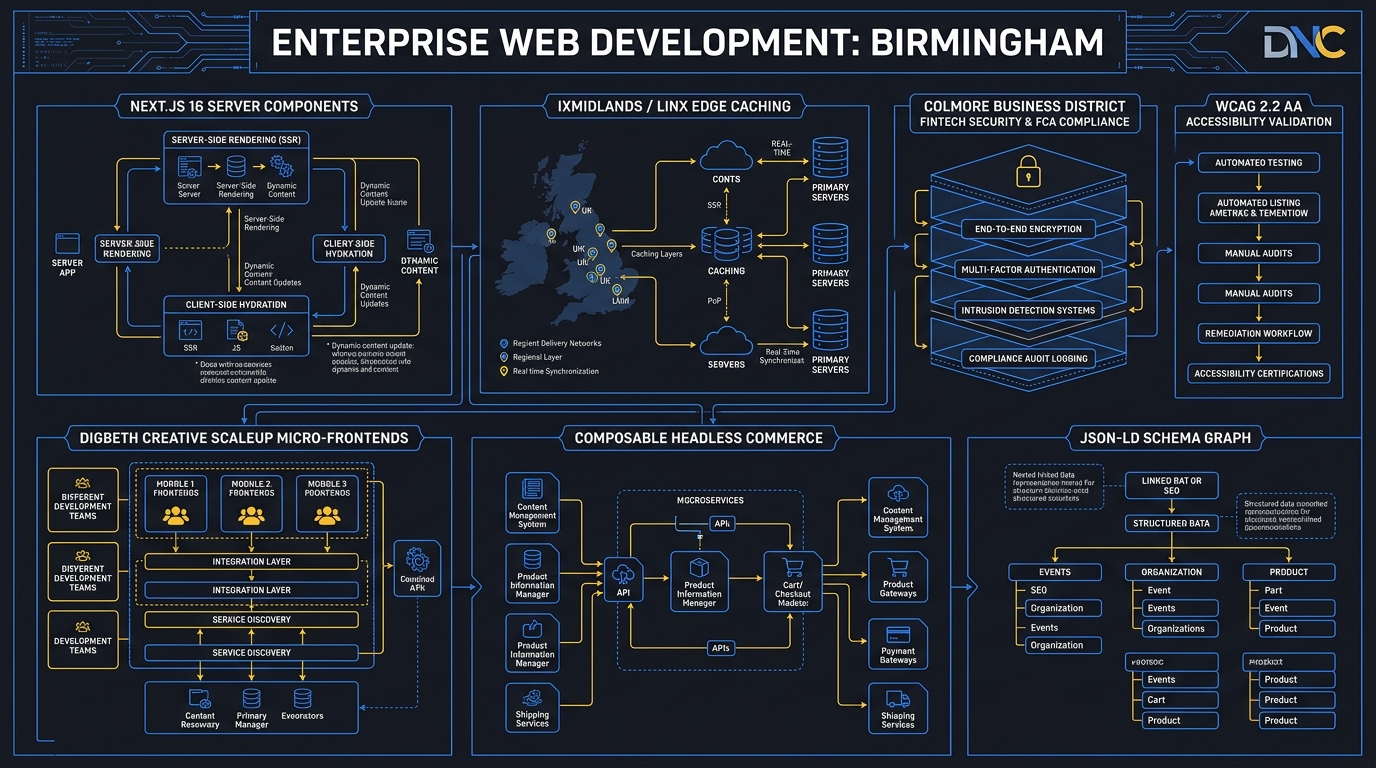
Modern enterprise web applications across Birmingham require frontend systems that eliminate bloated client JavaScript bundles while preserving rich interactive functionality. Utilizing the Next.js App Router and React Server Components, our team moves intensive computation directly to distributed edge networks. This architectural separation ensures instantaneous initial page loads, lowers Time to First Byte, and eliminates cumulative layout shifts, delivering snappy and predictable interface responses to corporate users across desktop workstations and mobile devices throughout the West Midlands.
We deploy production assets directly to localized edge points of presence connected to the London Internet Exchange (LINX) Regional Peering Architecture and regional carrier facilities across the Midlands. By routing network requests through high-speed West Midlands fiber rings and enforcing advanced compression protocols, we ensure all dynamic and static payloads resolve with minimal latency. Our development methodology strictly adheres to official Next.js Documentation standards, empowering Birmingham organizations to achieve flawless Core Web Vitals performance.
3. Colmore Business District Fintech & FCA Governance
The Colmore Business District represents the premier financial and professional services core of Birmingham, where institutional banking firms, wealth managers, and fintech challengers require web applications engineered with zero-trust security paradigms. Financial digital platforms cannot afford software regressions, vulnerable third-party dependencies, or ambiguous transactional states. User authentication workflows, role-based access controls, and ledger calculations must execute with mathematical determinism during high-volume market sessions. Frontend architectures must proactively defend critical financial records against cross-site scripting vulnerabilities, injection threats, and unauthorized data exfiltration.
Our full-stack engineers design every platform to comply with regulatory standards set by the Financial Conduct Authority (FCA) Consumer Duty Framework. We implement deterministic form validation, clear fee disclosures, and immutable audit logs across transactional workflows. All data storage layers, session handlers, and encryption protocols strictly adhere to UK GDPR Guidance and Accountability Framework directives from the Information Commissioner's Office. Birmingham financial enterprises trust our hardened architectures to protect intellectual property, ensure regulatory sovereignty, and withstand stringent compliance audits.
| Architecture / Capability | Legacy / Template Monolith | DesignNCode Modern Engineering |
|---|---|---|
| Core Web Vitals & Edge Latency | Bloated JavaScript bundles with slow server response times and high layout shifts | Server components and Midlands edge caching delivering sub-100ms loads and zero CLS |
| Regulatory & Security Governance | Vulnerable third-party plugins with inadequate UK GDPR and FCA audit trails | Zero-trust authentication, deterministic forms, and comprehensive UK statutory compliance audits |
| Scalability & Cloud Architecture | Brittle monolithic servers that crash during high-concurrency traffic surges | Modular micro-frontends and auto-scaling multi-region Kubernetes cloud infrastructure |
| Accessibility & Inclusivity | Surface-level styling patches failing modern UK Equality Act standards | Native WCAG 2.2 AA compliant markup and verified screen reader accessibility trees |
4. Digbeth Scaleup Velocity & Composable Micro-Frontends
Fast-growing creative technology agencies and digital scaleups in Digbeth and the Custard Factory face constant pressure to deploy complex application features quickly while expanding their engineering teams. When multiple cross-functional product squads commit code to a single monolithic repository, release pipelines stall, merge conflicts multiply, and regression risks escalate. Scaling modern web platforms requires modular frontend architectures that empower independent feature squads to develop, test, and deploy domain-specific software modules autonomously without compromising systemic platform stability.
DesignNCode architects scalable micro-frontend architectures and composable design systems that decompose complex web applications into isolated business domains. By establishing unified TypeScript interfaces, automated continuous delivery pipelines, and centralized UI design tokens, we empower Birmingham development teams to shorten sprint cycles and eliminate release bottlenecks. Our clean architectural boundaries allow engineering leaders to scale product velocity predictably and adopt emerging cloud microservices smoothly. Explore our featured projects to examine our modular web implementations in detail.
Web Development Architecture & Delivery Matrix: Birmingham
5. High-Concurrency Headless Commerce for Midlands Retail
Birmingham and the wider West Midlands region represent a dynamic retail and manufacturing commerce hub, home to luxury jewelers in the Jewellery Quarter, direct-to-consumer brands, and major multi-channel retailers. High-traffic digital storefronts process thousands of concurrent transactions where subtle page latency or confusing navigation steps directly cause shopping cart abandonment. Demanding online shoppers expect instant product discovery, fluid catalog filtering, and transparent shipping calculators that guide them effortlessly from initial browsing to one-click payment finalization.
We build headless e-commerce platforms that integrate our custom UI/UX design services with scalable Shopify and e-commerce development infrastructures. By decoupling frontend presentation layers from backend inventory systems via GraphQL APIs, we construct fluid product configurators, personalized recommendation carousels, and localized checkout funnels. Our hardware-accelerated image delivery and edge caching ensure high-resolution media showcases load instantly, helping Birmingham retail brands increase conversion rates, reduce bounce rates, and maximize lifetime customer value across global consumer markets.
6. WCAG 2.2 AA Accessibility & Legal Risk Mitigation
Digital accessibility represents both an essential engineering discipline and a mandatory statutory obligation under the UK Equality Act 2010. Modern enterprise web applications must provide universal access to all users, regardless of visual, auditory, cognitive, or motor impairments. Relying on superficial third-party accessibility overlay widgets or post-launch fixes exposes commercial organizations to legal penalties, public scrutiny, and customer churn. Enterprise websites must incorporate semantic document markup, logical keyboard navigation flows, and robust ARIA accessibility tree hierarchies directly within core application code.
DesignNCode integrates digital accessibility into every phase of our engineering lifecycle, building web platforms that strictly satisfy and exceed W3C Web Content Accessibility Guidelines (WCAG) 2.2 Level AA criteria. We conduct comprehensive automated linter checks, execute screen reader testing with NVDA and VoiceOver, and calibrate color contrast ratios across dynamic interface states. By adhering strictly to Equality Act 2010: Digital Service Provider Obligations, our team ensures Birmingham organizations provide inclusive digital experiences while insulating leadership from regulatory liability.
7. Generative Engine Optimization & Core Web Vitals Dominance
Achieving organic search dominance across competitive Birmingham business sectors demands web development aligned with modern search ranking algorithms and Generative Engine Optimization principles. Modern AI-assisted search engines and conversational discovery systems prioritize structured data, high-density informational content, and exceptional Core Web Vitals metrics. Web platforms suffering from slow server response times, high cumulative layout shifts, or missing semantic schema markup face severe visibility penalties, forfeiting high-value commercial search traffic to more agile and technically optimized regional competitors.
Our full-stack engineers embed multi-layered JSON-LD schema graphs, server-rendered semantic structures, and automated sitemaps into every Next.js build. Uniting technical frontend engineering with comprehensive SEO services, we ensure frictionless crawling and indexing by algorithmic search bots and AI answer engines alike. We optimize Largest Contentful Paint and Interaction to Next Paint to sub-second standards, ensuring Birmingham enterprises capture high-intent commercial queries and turn incoming organic search visitors into qualified enterprise leads and sales.
8. Enterprise Omnichannel Integration & Scalable Cloud Strategy
Enterprise web applications do not operate in isolation: they serve as central digital communication hubs orchestrating data across customer relationship management systems, marketing automation suites, enterprise resource planning databases, and support platforms. For Birmingham enterprises managing distributed offices and physical facilities across the Midlands, fragmented software integrations create data silos, delayed reporting, and disjointed client experiences. Modern web applications require resilient API middleware, asynchronous message queues, and secure webhook processors to maintain reliable bidirectional data flow across the technology stack.
We engineer unified enterprise software ecosystems that bridge frontend web interfaces with mission-critical backend systems and targeted performance marketing platforms. By architecting resilient RESTful endpoints and GraphQL services, our developers ensure data synchronizes accurately across corporate tools in real time. To discover how our senior engineering team can architect your next mission-critical web application, read more about our team or contact our engineering team today to schedule a comprehensive technical architecture consultation.
Client Reviews: Birmingham
"DesignNCode engineered an exceptional Next.js platform for our wealth management firm on Colmore Row. Their focus on zero-trust security, FCA compliance, and regional edge routing reduced our application latency by 65% and significantly accelerated our enterprise client onboarding workflow."
Edward Bradley
Chief Technology Officer, Midland Heritage Capital (Colmore Business District, Birmingham)
"Replatforming our high-volume digital retail operation in Birmingham required flawless mobile performance and sub-second checkout speeds. Ankita Malik and the DesignNCode team built a composable headless storefront that cut cart abandonment by 44% and delivered our highest conversion rates to date."
Sienna Vance
VP of Digital Commerce, Sovereign Jewellery & Luxury Goods (Jewellery Quarter, Birmingham)
Frequently Asked Questions
Why choose Next.js 16 over legacy monolithic platforms for Birmingham enterprises?+
Next.js 16 delivers React Server Components, localized edge caching, and sub-second execution. By stripping database bottlenecks and legacy script weight, Next.js provides higher conversion velocity, superior organic rankings, and resilient scalability for high-traffic West Midlands corporate ecosystems.
How do you guarantee UK GDPR and FCA compliance for Colmore fintech portals?+
We build compliance directly into software infrastructure using automated consent management, zero-trust authentication, encrypted storage, and transparent fee disclosures. Our deterministic user journeys undergo automated scans and audits to eliminate dark patterns completely.
What technical optimizations achieve sub-second Core Web Vitals scores?+
We leverage edge caching through regional Midlands IX peering, automated asset compression, zero-runtime CSS, and server rendering. By minimizing client JavaScript bundles and eliminating layout shifts, our team achieves sub-100ms response times consistently.
Can you migrate legacy West Midlands enterprise web systems without downtime?+
Yes, we implement a phased strangler fig migration strategy. By routing traffic through modern API gateways and incrementally replacing legacy monolithic components with independent Next.js micro-frontends, we ensure continuous operations and preserve database integrity.
How do you architect web platforms to handle volatile e-commerce traffic spikes?+
We build stateless containerized microservices deployed across multi-region cloud clusters with auto-scaling triggers. Combined with distributed Redis caching, asynchronous job queues, and edge CDN routing, our architectures absorb massive retail traffic surges effortlessly.
What is your approach to complete WCAG 2.2 AA accessibility compliance?+
Our developers construct semantic HTML hierarchies, accessible ARIA live regions, logical keyboard flows, and compliant colour contrast tokens from project inception. We conduct rigorous automated testing alongside manual screen reader audits to guarantee universal digital accessibility.
How do you tailor headless e-commerce architecture for Birmingham retail brands?+
We build bespoke headless storefronts utilizing Next.js coupled with Shopify Plus backends. This architecture delivers fluid visual transitions, high-resolution product storytelling, localized multi-currency checkouts, and responsive product filtering that maximize average order values.
What is the typical enterprise web development timeline in Birmingham?+
An enterprise web engagement typically spans six to twelve weeks, encompassing discovery, architecture blueprinting, sprint-based development, and thorough quality assurance. We maintain clear sprint demos, staging environments, and documentation to ensure seamless collaboration.
Authoritative Sources & Citations
The regulatory, technological, and architectural standards referenced across this publication.
Statutory regulatory standards mandating fair communication and consumer protection across digital platforms.
International technical criteria establishing accessible color contrast ratios and screen reader semantics.
Data protection standards regulating user consent architecture and enterprise information security.
Primary United Kingdom statute mandating non-discriminatory digital access and accommodations.
Technical specifications governing regional edge routing and low-latency Midlands interconnects.
Framework standards for server component rendering, edge performance, and layout stability.
