Key Architectural Takeaways
1. London Market Dynamics & Enterprise Interface Demands
The digital economy across London requires exceptional interface precision, connecting multinational enterprises in the Square Mile with agile technology scaleups across Shoreditch and the Silicon Roundabout corridor. As commercial capital flows across global financial markets, digital touchpoints represent the primary interface between institutional credibility and user adoption. Organisations across the City of London, Mayfair, and Canary Wharf operate in high-velocity competitive environments where poorly architected user flows directly impair transaction velocity, increase customer acquisition costs, and degrade corporate valuations.
DesignNCode architects modern user experiences engineered specifically for London enterprises demanding measurable conversion lift and friction-free user journeys. By fusing quantitative analytics with behavioural psychology, our team builds robust interface architectures that integrate seamlessly with high-performance web development services and complex cloud backends. We eliminate operational cognitive fatigue across multi-tiered workflows, ensuring enterprise web applications and customer-facing digital portals deliver intuitive navigation, rapid task completion rates, and sustained commercial engagement across diverse European and global user cohorts.
2. High-Stakes Fintech Usability & FCA Regulatory Governance
London stands as Europe's preeminent financial capital, where fintech platforms in Canary Wharf and algorithmic trading hubs require rigorous data density visualization and deterministic transaction flows. Financial applications cannot rely on superficial visual aesthetics when handling complex portfolio rebalancing, cross-border payments, or institutional lending protocols. Micro-interactions must communicate transactional certainty, whereas information hierarchies must present complex regulatory disclosures without overwhelming active traders, retail investors, or institutional asset managers navigating volatile market data streams under extreme cognitive loads.
Our engineering methodologies align interface design directly with strict regulatory mandates enforced by the Financial Conduct Authority (FCA) under the landmark Consumer Duty framework. Every interactive component, modal confirmation, and fee disclosure is built to prevent consumer friction and deceptive dark patterns. DesignNCode interfaces undergo rigorous user testing to guarantee algorithmic clarity and full compliance with UK Information Commissioner's Office (ICO) governance, ensuring financial enterprises protect client data rights across every digital interaction.
3. Luxury Brand Experience & Mayfair Digital Prestige
Luxury houses, private wealth family offices, and bespoke hospitality brands situated along Mayfair, Bond Street, and Knightsbridge demand digital platforms that reflect physical prestige and sensory refinement. Discerning high-net-worth clients expect digital interactions that mirror the exclusivity of private client suites, characterized by understated typography, harmonious spatial rhythms, and fluid motion design. Standard off-the-shelf templates dilute brand equity and fail to convey the artisanal heritage, bespoke craftsmanship, and institutional permanence demanded by prestigious London institutions.
We engineer immersive digital environments that elevate brand perception while maintaining frictionless checkout and private inquiry paths. Integrating our bespoke UI/UX design services with customized Shopify and e-commerce development infrastructures, DesignNCode translates luxury brand ethos into tactile digital touchpoints. Our bespoke typography scale, deliberate white-space management, and hardware-accelerated transitions establish emotional resonance, reinforcing premium pricing power and cultivating generational client loyalty across both domestic British clientele and affluent international patrons.
| Architecture / Capability | Legacy / Template Monolith | DesignNCode Modern Engineering |
|---|---|---|
| User Flow & Conversion Velocity | Fragmented multistep funnels with high abandonment rates | Deterministic task flows yielding 40%+ conversion surge |
| Design Token & Component Governance | Ad-hoc hardcoded CSS styles causing visual fragmentation | Centralized Figma-to-React tokens with CI lint validation |
| Accessibility & Regulatory Compliance | Surface-level styling failing Equality Act standards | Native WCAG 2.2 AA compliance and full FCA audit support |
| Core Web Vitals & Edge Latency | Bloated script bundles causing severe CLS and latency | Zero-layout-shift UI paired with Docklands LINX routing |
4. Scaleup Velocity & Shoreditch Atomic Design Systems
The venture ecosystem flourishing across Shoreditch, Old Street, and the King's Cross Knowledge Quarter demands rapid product velocity and design system modularity to satisfy ambitious funding milestones. Series A and Series B venture-backed software startups must launch feature releases continuously without introducing architectural fragmentation or technical debt into their frontend codebases. When engineering teams build ad hoc interfaces without unified token governance, component duplication compounds rapidly, driving up maintenance overhead and degrading the product experience for end users.
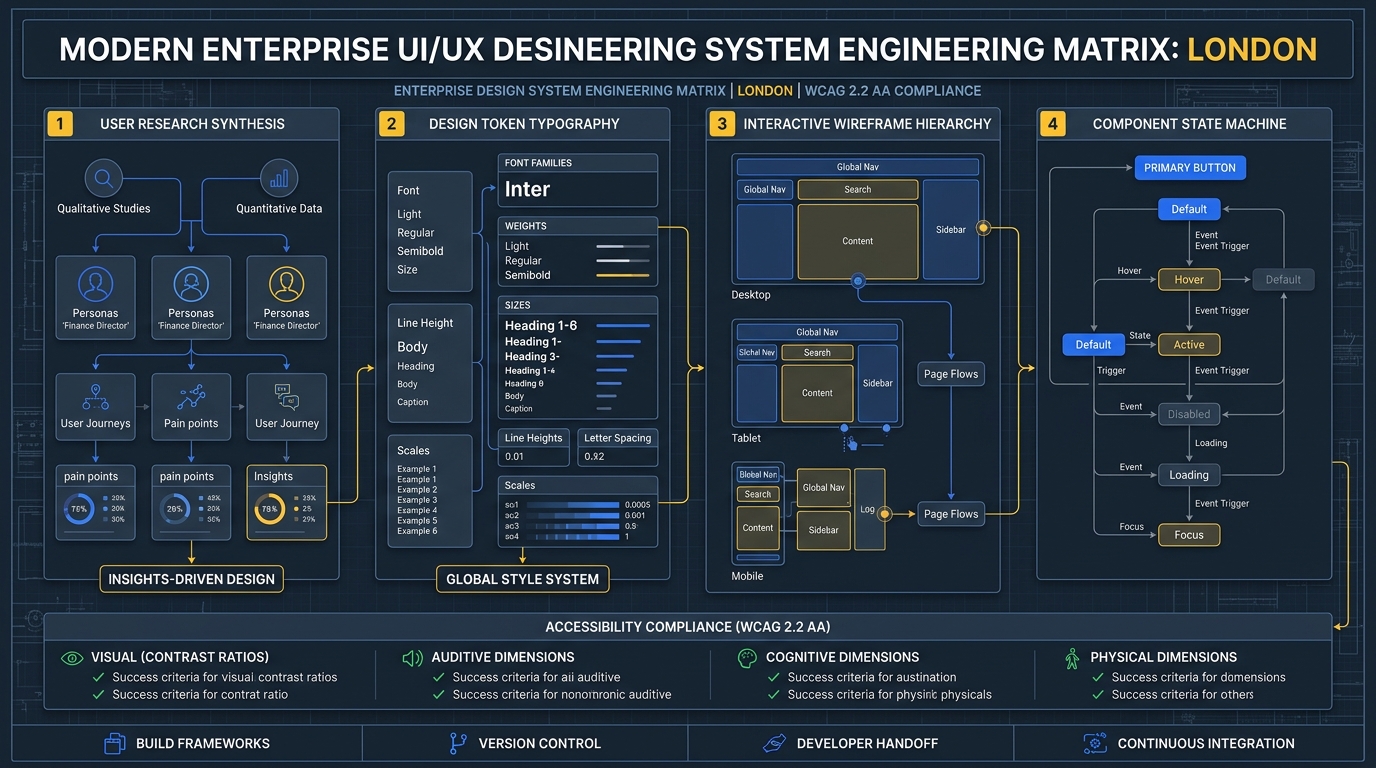
DesignNCode establishes resilient atomic design systems built on strict design tokens that bridge the divide between Figma design libraries and modern Next.js Documentation component repositories. Our structured component architectures govern typography tokens, spacing grids, colour states, and interactive feedback mechanisms. This systematic discipline empowers venture-backed engineering teams to accelerate frontend release cycles, maintain flawless visual coherence, and scale product suites effortlessly as documented in our featured projects across high-growth European tech sectors.
UI/UX Design Architecture & Delivery Matrix: London
5. Intellectual Property, Asset Protection & Brand Governance
Enterprise digital interfaces represent core intellectual property that must be protected, systematically documented, and governed across distributed corporate teams operating in multinational environments. Global corporations headquartered in London manage complex portfolios of digital sub-brands, requiring centralized design governance to avoid brand dilution and trademark vulnerabilities. Custom interface assets, proprietary icon sets, bespoke typography systems, and patented navigation interactions represent significant balance sheet investments that require rigorous legal clearance, version control, and brand asset management infrastructure.
We establish comprehensive digital brand guidelines and interactive documentation portals that maintain absolute design integrity across cross-functional departments, regional agencies, and third-party development partners. By integrating centralized design token management with automated linting tools in continuous integration pipelines, DesignNCode prevents unauthorized component drift. Our governance frameworks insulate enterprise organizations from intellectual property disputes, preserve brand consistency across global markets, and guarantee long-term operational resilience as your enterprise expands international service channels.
6. Accessibility Mandates & WCAG 2.2 AA Compliance Standards
Digital inclusivity is both an ethical imperative and a strict legal requirement across the United Kingdom, governed by the Equality Act 2010 and international digital accessibility standards. Modern enterprise interfaces must accommodate users across diverse cognitive, visual, auditory, and motor capabilities without compromising aesthetic sophistication. Failing to implement accessible navigation patterns, high-contrast colour ratios, and keyboard-navigable focus states exposes commercial organizations to legal liability, reputational damage, and the immediate exclusion of substantial market segments seeking equal digital access.
Our designers and frontend engineers build every digital product to meet and exceed W3C WCAG 2.2 AA Standards. We conduct rigorous screen reader testing, verify semantic HTML structures, construct accessible ARIA live regions, and implement compliant colour contrast tokens across every component state. By embedding accessibility verification directly into early wireframing and automated frontend testing, DesignNCode delivers inclusive digital experiences that insulate London enterprises from regulatory scrutiny while maximizing universal audience reach.
7. Edge Performance, Telecommunications & Technical Latency
Perceived user experience is inextricably bound to technical network latency and frontend rendering speeds, particularly across competitive metropolitan markets where milliseconds dictate conversion rates. In London, enterprise digital platforms rely on localized edge routing through carrier-neutral facilities such as Telehouse North in Docklands and the London Internet Exchange (LINX). Heavy client-side JavaScript bundles, unoptimized web fonts, and layout shifts degrade user satisfaction, elevate bounce rates, and compromise search engine indexing performance across modern generative search algorithms.
DesignNCode architects ultra-lightweight frontend presentation layers utilizing modern server components, zero-runtime styling, and next-generation image formats to achieve perfect Core Web Vitals scores. By optimizing cumulative layout shift (CLS) and largest contentful paint (LCP), our interfaces render instantaneously across mobile and desktop networks. Aligning technical frontend execution with comprehensive SEO services and conversion tracking ensures enterprise platforms achieve superior organic discovery while delivering frictionless responsiveness to demanding London corporate audiences.
8. Omnichannel Integration & Enterprise UX Strategy
Modern London consumer and business interactions span diverse physical and digital touchpoints, requiring seamless continuity between retail environments, mobile applications, and enterprise web dashboards. An executive reviewing quarterly financial analytics on an office workstation expects identical visual logic and data fidelity when accessing mobile interfaces during transit through Farringdon or Liverpool Street Station. Inconsistent user interfaces across touchpoints induce cognitive disorientation, erode user trust, and reduce conversion completion rates across complex multi-step buying journeys.
We formulate end-to-end omnichannel UX strategies that synchronize user mental models across every digital surface, ensuring persistent session states and intuitive cross-device task progression. Our multidisciplinary team combines user journey mapping with targeted performance marketing insights to maximize customer lifetime value. To discover how our strategic interface architecture can transform your enterprise conversion metrics, review about our team or contact our engineering team today for a comprehensive technical consultation.
Client Reviews: London
"DesignNCode completely revamped our institutional investment dashboard in Canary Wharf. Their deep understanding of data density, FCA regulatory compliance, and rapid user workflows helped us reduce client onboarding friction by 42% while earning unanimous praise from our tier-one institutional asset managers across Europe."
Alistair Vance
Chief Technology Officer, Meridian Capital Markets (Canary Wharf, London)
"Launching our luxury retail platform from Mayfair required absolute visual perfection and sub-second mobile responsiveness. Ankita Malik and the DesignNCode team engineered an atomic design system that doubled our mobile conversion rate while maintaining our prestigious heritage aesthetic."
Elena Rostova
VP of Digital Experience, Aurelia Haute Horlogerie (Mayfair, London)
Frequently Asked Questions
How does DesignNCode ensure UI/UX compliance with UK FCA Consumer Duty regulations?+
We engineer every financial interface with strict adherence to FCA Consumer Duty principles. Our team designs transparent fee disclosure modules, eliminates misleading dark patterns, optimizes microcopy for clarity, and conducts structured user testing to guarantee that consumers navigate complex financial products without cognitive confusion or unprompted friction.
What methodology does your team follow for enterprise design systems in London?+
We implement an atomic design architecture governed by strict design tokens across typography, colour spaces, and layout grids. These tokens synchronize seamlessly between Figma design workspaces and production React repositories, enabling cross-functional engineering teams in London to accelerate feature development while maintaining flawless visual consistency.
How do you achieve WCAG 2.2 AA accessibility compliance for enterprise platforms?+
Our designers and developers integrate accessibility into every project phase, verifying contrast ratios, screen reader accessibility trees, keyboard navigation paths, and accessible ARIA attributes. We conduct rigorous automated and manual audits to ensure complete compliance with Equality Act 2010 mandates and international accessibility standards.
Can DesignNCode modernize legacy enterprise software without disrupting ongoing operations?+
Yes, we employ a phased micro-frontend modernization strategy that upgrades legacy user interfaces incrementally. By mapping critical user workflows and introducing modular component architectures, we enhance usability and user velocity while preserving core backend stability and preventing operational downtime across mission-critical enterprise systems.
How does localized UI/UX design improve conversion rates for London luxury brands?+
Luxury consumers expect understated visual elegance, harmonious whitespace, and tactile digital micro-interactions that mirror in-person prestige. We design bespoke typography hierarchies, fluid hardware-accelerated animations, and frictionless private consultation booking flows that elevate brand perception, reinforce premium pricing power, and drive high-value conversions.
What is the typical timeline and discovery process for a London UI/UX project?+
A typical enterprise UI/UX engagement spans four to eight weeks, commencing with stakeholder discovery, user persona research, and competitive intelligence mapping across London submarkets. We then iterate rapidly through interactive wireframes, high-fidelity prototypes, user testing validations, and comprehensive developer handoff documentation.
How do your UI/UX designs integrate with Next.js and modern frontend frameworks?+
Our UI/UX architects build design systems directly compatible with modern Next.js server components and Tailwind CSS frameworks. By specifying exact layout constraints, zero-runtime CSS properties, and responsive breakpoints, we ensure frontend developers translate visual prototypes into production-ready, high-performance web applications without layout shifts.
How do you optimize mobile user interfaces for London's fast-moving business professionals?+
We optimize mobile experiences for rapid one-handed navigation and quick cognitive processing during urban transit. By prioritizing key user actions within thumb-reach zones, implementing skeleton loading states, and eliminating extraneous form fields, we enable busy professionals to complete complex tasks efficiently on the go.
Authoritative Sources & Citations
The regulatory, technological, and architectural standards referenced across this publication.
Statutory governance requiring clear communications, transparent pricing structures, and friction-free user journeys across digital financial products.
International technical criteria establishing accessible contrast ratios, focus states, screen reader semantics, and cognitive inclusion rules.
Data protection standards regulating user consent architecture, data subject rights, and cookie preferences on enterprise platforms.
Primary United Kingdom legislation mandating non-discriminatory digital access and reasonable accommodation across commercial websites.
Technical network infrastructure specifications detailing edge routing, sub-millisecond interconnects, and Docklands telecommunications peering.
Performance framework standards for server-rendered interfaces, layout shift mitigation, and optimized font delivery systems.
