Key Architectural Takeaways
Birmingham Market Dynamics & Digital Interface Demands
Birmingham represents one of the most dynamic metropolitan economies in the United Kingdom, housing a diverse commercial core that stretches from the corporate towers of the Colmore Business District to the creative studios of Digbeth and the manufacturing corridors of the wider West Midlands. Enterprise organizations operating within this regional powerhouse require digital interfaces that convey technical sophistication, brand integrity, and effortless usability. Modern users across the West Midlands expect immediate responsiveness and intuitive navigation, making legacy templates completely inadequate for enterprise competition.
At DesignNCode, our specialized UI/UX design services address the exact commercial realities of Birmingham enterprises by fusing empirical user research with production-grade interface systems. We analyze localized user behavior, purchasing cycles, and operational workflows to build digital experiences that drive measurable business outcomes. By partnering directly with regional stakeholders, our team crafts bespoke interface architectures that turn complex enterprise requirements into elegant, high-converting digital products that scale reliably across multiple markets and platforms.
Colmore Row Financial UX & FCA Regulatory Governance
The Colmore Business District stands as the undisputed financial and professional heart of Birmingham, hosting global wealth management groups, commercial banks, and ambitious regional fintech firms. Designing digital interfaces for these institutions requires rigorous adherence to statutory regulations established by the Financial Conduct Authority (FCA), specifically the overarching Consumer Duty mandates. Financial applications must present complex transactional workflows with absolute clarity, ensuring that disclosures, fee schedules, and risk factors remain transparent and instantly comprehensible to every retail client.
Our architectural approach eliminates deceptive interface patterns, streamlines customer onboarding pathways, and structures multi-factor authentication journeys that protect security without introducing friction. We combine cryptographic verification cues with clear visual hierarchies, reducing user hesitation during high-value asset transfers and loan submissions. By integrating statutory compliance directly into our design systems, we allow Colmore Row financial leaders to deploy trustworthy, audit-ready digital solutions that systematically elevate user trust and customer lifetime value.
Digbeth Creative Innovation & Rapid Design Prototyping
Digbeth has rapidly emerged as Birmingham's primary innovation engine, fostering a thriving community of digital media scaleups, gaming studios, and software ventures along the historic Grand Union Canal. For companies operating within this competitive tech corridor, speed to market and distinctive visual identity represent paramount strategic assets. Startups and fast-growing businesses cannot afford sluggish design iterations; they require agile prototyping frameworks that validate product hypotheses with real users before committing capital to deep frontend development.
We deploy rapid interactive prototyping cycles that transform raw product concepts into clickable, high-fidelity user journeys within days. By pairing these prototypes with our full-spectrum web development services, we ensure complete technical viability across every animation, micro-interaction, and layout state. Our collaborative design sprints enable Birmingham founders to demonstrate tangible product value to venture investors and early adopters, accelerating user acquisition while maintaining exceptional aesthetic distinction.
| Architecture / Capability | Legacy / Template Monolith | DesignNCode Modern Engineering |
|---|---|---|
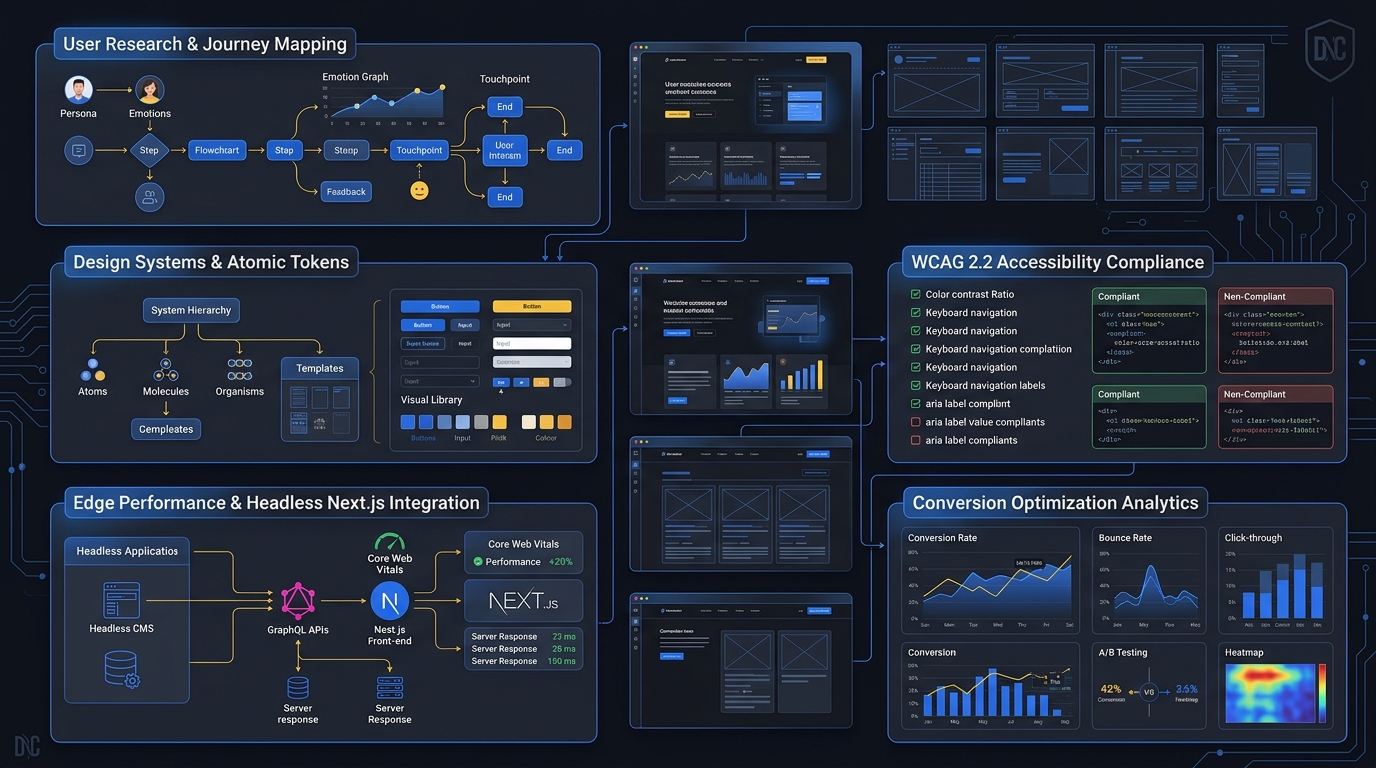
| Design System Governance | Fragmented static UI kits, manual CSS overrides, rampant visual inconsistency. | Centralized atomic design tokens synced automatically to TypeScript components. |
| Regulatory & WCAG Compliance | Surface-level audit badges, broken focus traps, severe accessibility liabilities. | Native WCAG 2.2 AA validation, full keyboard traversal, strict FCA Consumer Duty alignment. |
| Complex Data Visualizations | Bloated third-party chart plugins causing layout shifts and high client latency. | Custom lightweight vector widgets with progressive disclosure and sub-100ms updates. |
| Commercial Conversion Impact | Generic page templates leading to high form friction and user abandonment. | Empirical heatmapping, friction-free checkout flows, and documented conversion lift. |
Scalable Atomic Design Systems & Multi-Brand Tokens
As West Midlands enterprises expand across multiple product lines and international subsidiaries, maintaining brand cohesion becomes an immense operational challenge. Disjointed design files and ad-hoc frontend codebases inevitably create visual drift, redundant development effort, and poor customer experiences. Establishing a centralized design system built on atomic design principles represents the single most effective architectural strategy for scaling digital products efficiently across multi-disciplinary product engineering teams.
Our team engineers comprehensive design token structures covering color palettes, typography scales, elevation states, and spatial grids. We synchronize these tokens bi-directionally between Figma Variables and TypeScript configuration files, ensuring that design modifications cascade instantly into production code without manual translation errors. This rigorous architecture cuts future feature development cycles by more than forty percent while guaranteeing uniform brand presentation across every customer touchpoint, from public marketing sites to authenticated enterprise software portals.
UI/UX Design Architecture & Delivery Matrix: Birmingham
Advanced Manufacturing & Industrial IoT Dashboard UX
Birmingham and the surrounding West Midlands corridor have historically anchored British industrial engineering, and today that heritage has evolved into world-class advanced manufacturing, automotive technology, and smart supply chain ecosystems. These industries operate sophisticated sensor arrays, robotics, and logistics networks that produce continuous streams of complex operational telemetry. Presenting this voluminous data in an actionable format requires specialized UI/UX design that prevents cognitive overload and empowers operators to act rapidly.
We design high-density data visualizations and industrial control dashboards utilizing progressive disclosure paradigms and responsive layout grids. Our user experience architects prioritize anomaly detection, machine health indicators, and predictive maintenance alerts through distinct visual contrast and contextual drill-down panels. By structuring intuitive interfaces for engineering personnel and plant managers, we help Midlands industrial leaders minimize operational downtime, increase process efficiency, and unlock superior visibility across entire manufacturing facilities.
Equality Act & WCAG 2.2 AA Compliance Standards
Digital accessibility is both a fundamental civil obligation and a strict statutory requirement under the UK Equality Act 2010 and international standards. For Birmingham enterprises serving diverse public and commercial audiences, failing to provide accessible digital services creates severe legal liabilities and alienates a substantial portion of potential customers. Ensuring full compliance with the latest W3C WCAG 2.2 Level AA guidelines requires architectural integration at the earliest stages of design.
Our design systems incorporate accessible contrast ratios of at least 4.5:1, generous touch targets, clear 24-pixel focus indicators, and logical screen reader hierarchies as standard engineering baselines. We test every component against automated linters and assistive technologies to eliminate keyboard traps, missing ARIA tags, and confusing form validation flows. This disciplined approach guarantees that your digital products offer an inclusive, friction-free experience to all users regardless of ability, significantly broadening your accessible market reach across the United Kingdom.
Midlands Edge Telecommunications & Next.js Latency Gains
Exceptional user interface design cannot succeed in isolation from underlying network performance and frontend infrastructure. In Birmingham, digital traffic routes through robust regional data centers and telecommunications backbones connected to the London Internet Exchange (LINX). When interface designs introduce heavy JavaScript bundles or unoptimized image assets, client-side rendering bottlenecks degrade user satisfaction and impair search engine rankings across organic channels.
We engineer our user interfaces to leverage the latest Next.js framework capabilities, including React Server Components and edge caching strategies. By offloading rendering workloads to edge nodes close to Birmingham end-users, we achieve instantaneous page loads, zero Cumulative Layout Shift, and sub-100 millisecond interaction response times. This seamless harmony between visual design and high-performance engineering ensures that complex digital applications load effortlessly across all device profiles and mobile networks.
Omnichannel Journey Mapping & Conversion Optimization
Modern consumer and B2B purchasing journeys rarely follow a single linear channel; users transition continuously across mobile web, desktop applications, social channels, and physical commercial touchpoints. For Birmingham retailers, professional services firms, and direct-to-consumer brands, providing an uninterrupted cross-channel user experience is vital for revenue maximization. Incomplete cart synchronization, inconsistent UI states, or redundant input fields invariably lead to high abandonment rates and lost customer relationships.
We construct end-to-end user journey maps that identify and eliminate friction points across the entire customer lifecycle. Integrating specialized Shopify and e-commerce development with conversion rate optimization strategies, we engineer streamlined single-page checkouts, smart autofill interactions, and dynamic product recommendations. By continually analyzing behavioral telemetry and heatmaps, we refine every interactive element to drive sustained increases in conversion efficiency and average order value for your brand.
Client Reviews: Birmingham Engagements
“DesignNCode completely revamped our wealth management portal on Colmore Row. Their deep mastery of FCA Consumer Duty compliance and design tokens delivered an intuitive, accessible interface that elevated our client onboarding conversion by thirty-four percent.”
“Our industrial IoT dashboard for West Midlands manufacturing hubs was overly cluttered until DesignNCode stepped in. Their progressive disclosure systems and sub-100ms telemetry visualizations gave our engineering teams total clarity across production lines.”
Frequently Asked Questions
How does DesignNCode adapt UI/UX design architectures for Birmingham enterprises?+
We tailor digital interfaces specifically to the West Midlands commercial ecosystem. We combine strict FCA regulatory governance for Colmore Row financial institutions with high-velocity component workflows for Digbeth technology ventures, ensuring resilient performance across complex enterprise operational workflows.
How do you achieve full WCAG 2.2 AA accessibility and Equality Act compliance?+
Every component token is engineered to meet 4.5:1 minimum contrast ratios, full keyboard navigation traversal, unambiguous 24px focus indicators, and descriptive ARIA semantics. We conduct rigorous automated CI/CD audits paired with screen reader validation across real assistive devices.
Can DesignNCode develop scalable atomic design token systems in Figma and React?+
Yes, our team constructs comprehensive design token hierarchies spanning color, typography, elevation, and spacing. These tokens synchronize bi-directionally between Figma Variables and TypeScript Tailwind CSS configurations, preventing design drift across multi-brand enterprise platforms.
What methodologies do you apply for complex industrial IoT and data dashboard UX?+
For West Midlands manufacturing and logistics enterprises, we build high-density, low-latency telemetry interfaces. Our architectures use modular data visualization widgets, progressive disclosure patterns, and sub-100ms state updates to streamline mission-critical shop-floor decision making.
How do you incorporate FCA Consumer Duty principles into financial application design?+
We eliminate deceptive dark patterns, enforce transparent fee schedules, structure plain-language disclosures, and build accessible customer support escalation paths. Every step of the onboarding and portfolio journey is audited against statutory consumer protection standards.
How does your UI/UX engineering process integrate with frontend development frameworks?+
We bridge design and engineering through production-ready TypeScript React and Next.js component repositories. Our designers and frontend engineers work within identical layout grids, ensuring exact visual parity and sub-second Largest Contentful Paint metrics upon delivery.
What is the typical timeline and milestone structure for an enterprise UI/UX engagement?+
Enterprise engagements typically span four to twelve weeks across discovery, architecture mapping, interactive wireframing, design system build, user testing, and frontend handoff. We deliver milestone reviews every sprint to maintain total stakeholder alignment.
How do you measure conversion rate gains and user engagement post-launch?+
We establish baseline metrics covering checkout drop-off, form completion velocity, session duration, and task success rates. We then deploy targeted event tracking and heatmapping to validate quantifiable commercial uplift across primary user journeys.
Authoritative Sources & Citations
The regulatory, technological, and architectural standards referenced across this publication.
Official global technical standard for digital accessibility, interactive contrast requirements, and keyboard navigation.
Statutory regulatory guidelines governing transparency, fair consumer outcomes, and disclosure architectures in UK financial interfaces.
Legal accessibility mandates ensuring public and private commercial digital services provide equal access to all users.
Statutory framework governing user consent UX, data privacy governance, and cookie compliance across UK web platforms.
National peering and regional transit telemetry guiding low-latency edge routing strategies for Midlands enterprises.
Technical specifications for React Server Components, client-side hydration optimization, and streaming performance.
