Key Architectural Takeaways
1. Search Convergence & Paid-to-Organic Pipeline Synergies
Modern enterprise customer acquisition demands an integrated framework where search engine optimization and performance marketing operate as unified disciplines. Historically, paid media teams and organic search architects operated in departmental silos, causing bidding competition on self-cannibalizing terms and duplicate conversion funnels. By engineering a synchronized data layer between Google Ads search query performance and organic crawl logs, organizations identify transactional keywords where organic dominance can absorb paid traffic safely. This dynamic allocation shifts paid budget toward contested exploratory keywords while securing high-intent organic positions, establishing a resilient growth flywheel that insulates acquisition channels from sudden advertising market price fluctuations.
Furthermore, running coordinated paid and organic campaigns yields higher combined click-through rates than isolated channels can achieve independently. When a prospect encounters an enterprise brand across both top sponsored listings and authoritative organic knowledge snippets, brand trust increases exponentially. This dual visibility reinforces domain authority, signals market leadership, and lowers cost per acquisition across complex B2B buying committees. At DesignNCode, our performance marketing strategists and technical search engineers synchronize campaign telemetry daily, ensuring digital media investments create durable, compounding domain equity rather than ephemeral click volume.
2. Headless SSR Architecture, Core Web Vitals & Sub-Second Latency
Technical performance represents the foundational bedrock of organic search indexation and paid conversion efficiency. Legacy monolithic platforms and heavy client-side JavaScript applications introduce render-blocking overhead, delaying First Contentful Paint and severely hurting Core Web Vitals metrics. By engineering modern digital assets with Next.js 16 Server Components and edge computing environments, our web development services deliver pre-rendered, semantic HTML directly to client devices in under one hundred milliseconds. Eliminating client-side hydration bottlenecks ensures search engine crawlers parse critical editorial content immediately without consuming excessive rendering compute resources.
Sub-second page rendering produces immediate economic benefits across both organic ranking algorithms and paid advertising auctions. Search engines reward lightning-fast response times with elevated crawl frequencies and preferential ranking distribution. Simultaneously, Google Ads awards superior Quality Scores to landing destinations with near-zero Cumulative Layout Shift and instantaneous Interaction to Next Paint metrics. This technical superiority directly reduces cost per click bids in competitive commercial auctions, allowing performance marketers to capture greater market share at lower operational expense while offering visitors an effortless user experience.
3. Generative Engine Optimization & Vector Semantic Schema
The rapid evolution of artificial intelligence search assistants, including Google Gemini and ChatGPT Search, has revolutionized enterprise search discovery. Generative Engine Optimization requires shifting from simple keyword density toward deep semantic entity structuring and multidimensional knowledge graph integration. LLM-driven search engines evaluate content based on factual accuracy, technical depth, clear source attribution, and logical entity connectivity. By structuring corporate assets with extensive JSON-LD semantic schema and rich vector-aligned data hierarchies, we ensure artificial intelligence models recognize your enterprise as the undisputed authority within your commercial market.
Establishing vector entity dominance protects brand visibility as traditional search engine result pages transition to synthesized AI overviews. When large language models generate direct answers for enterprise procurement queries, they cite domains exhibiting structured data clarity and comprehensive topical depth. Our advanced SEO services incorporate deep knowledge graphs, verified authorship metadata, and authoritative reference citations. This deliberate architectural rigor guarantees your commercial solutions earn prominent placements inside AI citations, driving qualified decision-makers straight to your revenue funnels.
| Architecture / Capability | Legacy / Template Monolith | DesignNCode Modern Engineering |
|---|---|---|
| Rendering & Crawl Budget | Heavy client-side JavaScript, hydration delays, and slow crawler execution. | Next.js 16 edge SSR, sub-100ms response, and instant crawler discovery. |
| GEO & Semantic Entities | Basic meta tags, flat keywords, and absence of structured vector schema. | Deep 5-schema JSON-LD graphs, vector nodes, and prime LLM AI citations. |
| Paid & Organic Convergence | Siloed campaign teams, self-cannibalization, and inflated ad spend. | Unified data layer, automated keyword shifts, and blended CAC compression. |
| Conversion Funnel Speed | Bloated third-party trackers, layout shifts, and high mobile bounce rates. | Zero layout shift, server-side attribution, and optimized conversion flow. |
4. Multi-Touch Attribution, Conversion Modeling & Privacy Compliance
Accurate conversion attribution has grown increasingly complex amid stricter privacy regulations and third-party cookie depreciation. High-growth enterprises require advanced first-party data tracking systems capable of attributing revenue across multi-touch customer journeys without violating regulatory standards. By deploying server-side tracking pipelines, custom event brokers, and advanced media mix modeling, we capture granular prospect interactions across both organic discovery touchpoints and paid retargeting channels. This comprehensive visibility clarifies how organic search acts as a critical top-of-funnel discovery catalyst that accelerates pipeline velocity and amplifies downstream paid performance.
Maintaining rigorous compliance with regulatory bodies, such as the Information Commissioner's Office and global data privacy mandates, is essential for brand integrity. Our data collection architecture processes user consent deterministically while preserving analytics precision through cookieless server-side telemetry. By tying verified conversion outcomes directly to specific search queries, landing page templates, and media channels, executive leadership gains actionable intelligence into real return on investment. This data-driven clarity empowers marketing leaders to allocate capital efficiently, scale proven organic growth vectors, and eliminate wasted expenditure.
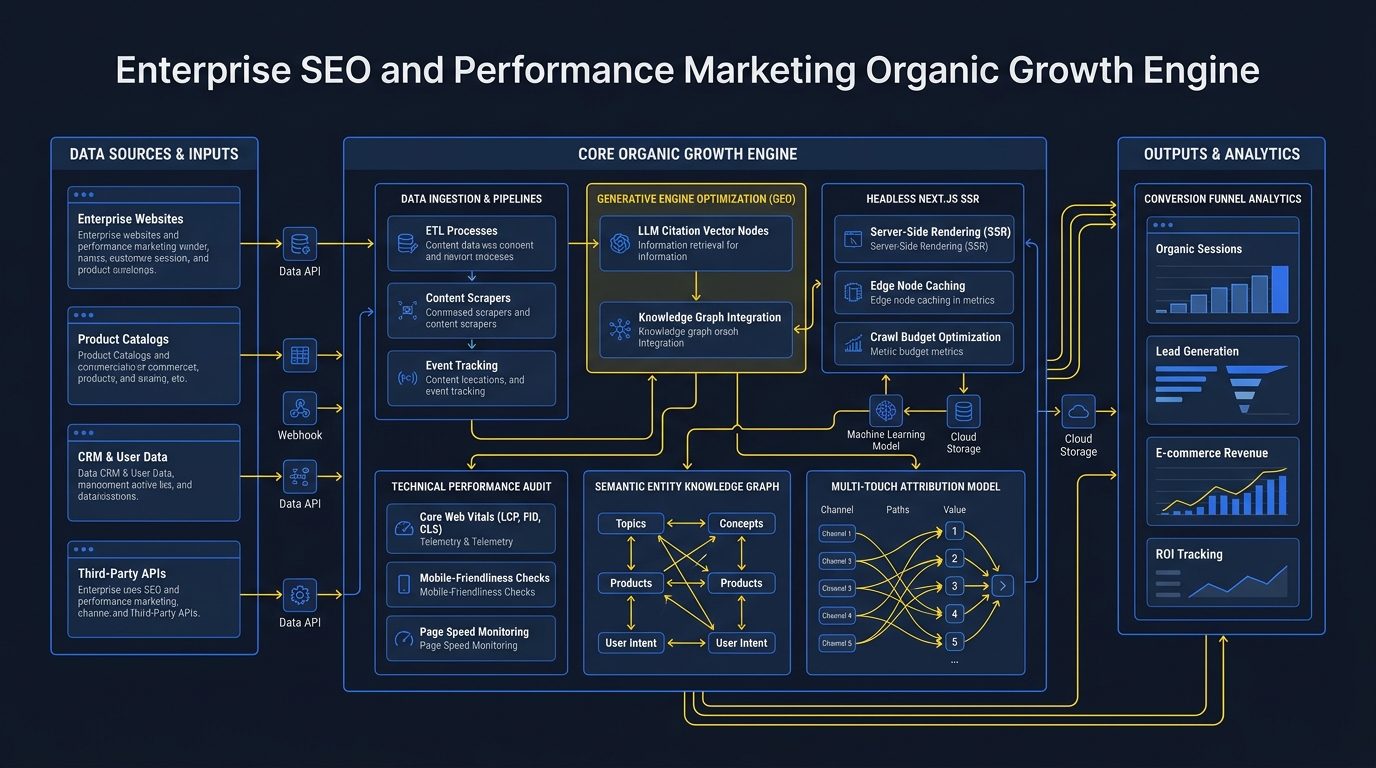
Enterprise SEO & Performance Marketing Engine Architecture
5. High-Velocity Programmatic Search Hubs & High-Intent Landing Pages
Capturing long-tail transactional search intent at scale requires programmatic architecture engineered for velocity and uniqueness. Manual page creation cannot match the speed or geographic granularity required to dominate hundreds of vertical industry niches. Utilizing database-driven static generation, headless content systems, and dynamic component libraries, we generate thousands of customized, high-intent landing pages. Each programmatic page features bespoke contextual data, real-time pricing indicators, customer case studies, and tailored conversion pathways, satisfying search intent thoroughly while eliminating keyword cannibalization across all target search terms.
To prevent low-quality algorithmic penalties, our programmatic systems integrate strict editorial governance and automated content uniqueness validation. Every landing template combines intuitive UI/UX design services with frictionless user journeys, ensuring prospects encounter high-utility interactive calculators, comparison tables, and direct booking mechanisms. By bridging programmatic organic search scale with performance marketing conversion principles, our engineering solutions capture enterprise demand at fractional marginal costs, driving sustainable pipeline expansion across all target commercial verticals.
6. Edge Crawl Budget Engineering, Edge Caching & Bot Management
Large-scale enterprise websites often suffer from crawl budget waste, where search engine spiders exhaust processing resources on low-value URLs and faceted navigation parameters. When search engine bots spend time on duplicate filter combinations rather than core commercial pages, newly published content languishes in indexation queues for weeks. We engineer sophisticated edge routing rules and dynamic sitemap architectures that guide web crawlers toward high-priority revenue assets. By intercepting requests at cloud edge nodes, we serve cached static responses instantly while restricting non-essential bot traffic from consuming origin server capacity.
Real-time log file auditing provides our technical team with deep operational visibility into crawler behavior and indexation velocity. By analyzing HTTP status code distributions, crawl frequency trends, and edge cache hit ratios, we immediately isolate and resolve crawl anomalies before they impact organic rankings. This technical optimization ensures newly published programmatic hubs and product landing pages index within hours of deployment, delivering immediate traffic and conversion uplift to support your broader digital marketing initiatives.
7. Conversion Rate Optimization & Full-Funnel CAC Compression
Driving millions of organic search impressions yields zero enterprise value if landing page architectures fail to convert visitors into paying clients. Conversion rate optimization must be engineered into every template from the initial wireframe stage, rather than appended as an afterthought. We implement neuromarketing design principles, clear visual hierarchies, and high-contrast call-to-action triggers that direct user attention toward commercial goals. By minimizing input form friction, offering one-click authorization, and providing instant consultation scheduling, we turn casual search traffic into committed pipeline revenue.
Continuous multivariate testing on high-traffic landing pages validates typography choices, value proposition copy, and micro-conversion placements. Our engineering team builds automated A/B testing infrastructure that executes tests without compromising page speed or generating layout shifts that could harm Core Web Vitals. Discover how our digital solutions accelerate client revenue across Shopify and e-commerce development ecosystems, optimizing every user touchpoint to compress blended customer acquisition costs and maximize lifetime customer value.
8. Continuous Algorithmic Monitoring & Predictive Revenue Forecasting
Search engine ranking algorithms and AI search synthesis parameters update continuously, requiring vigilant technical governance and automated regression testing. Relying on periodic manual audits leaves enterprise revenue exposed to unexpected algorithmic penalties and sudden visibility drops. We deploy automated synthetic monitoring agents that inspect Core Web Vitals health, structured schema validity, and indexation status across every core page template daily. Any unexpected drop in technical health triggers immediate engineering alerts, enabling rapid remediation before visibility shifts affect business performance.
Predictive analytics models combine historical organic search volume, seasonal demand variations, and paid media bid landscapes to forecast quarterly revenue velocity accurately. By viewing search performance through financial metrics rather than vanity keyword ranks, our clients make strategic capital investment decisions with complete confidence. Explore our featured projects to inspect enterprise performance transformations, or connect directly with our senior technologists to architect your unified organic growth engine.
Client Reviews & Performance Outcomes
"DesignNCode re-engineered our SaaS web platform with Next.js Server-Side Rendering and programmatic search hubs. Our organic pipeline doubled in four months while blended customer acquisition costs dropped by 38%."
"Their integration of Generative Engine Optimization and multi-touch server attribution gave us unprecedented clarity on organic search value. Their technical execution is truly elite."
Frequently Asked Questions
How does technical SEO directly reduce blended customer acquisition cost?↓
Technical SEO establishes persistent organic search equity on high-intent transactional queries. As organic impressions scale alongside paid search campaigns, total media reliance decreases, compressing blended customer acquisition cost across the full customer acquisition lifecycle.
Why is Server-Side Rendering critical for paid and organic search synergy?↓
Server-Side Rendering delivers pre-rendered HTML to web crawlers and human visitors in under two hundred milliseconds. This instant content delivery ensures full search engine indexing, improves quality scores on paid landing pages, and minimizes bounce rates.
What is Generative Engine Optimization and how does it drive performance traffic?↓
Generative Engine Optimization structures editorial content with semantic vector entities, schema markup, and verifiable technical data. This architecture ensures large language models and AI search agents cite your brand as the authoritative primary source.
How do programmatic landing pages avoid duplicate content penalties?↓
Programmatic pages utilize unique datasets, proprietary conversion tools, dynamic schema graphs, and localized market intelligence. By delivering distinct editorial value and modular UX components, each URL satisfies strict quality guidelines without keyword cannibalization.
How does edge caching optimize search engine crawl budgets?↓
Edge caching offloads computational overhead by serving static HTML snapshots from global points of presence. Search engine crawlers consume zero backend database cycles, allowing rapid indexation across tens of thousands of dynamic enterprise landing pages.
What attribution models best measure organic and paid search co-dependencies?↓
First-party data pipelines combining Markov chain multi-touch attribution and media mix modeling accurately capture search synergy. These models isolate how organic research touchpoints warm top-of-funnel traffic, accelerating paid retargeting velocity and pipeline conversions.
How do Core Web Vitals impact Google Ads Quality Score and organic rankings?↓
Sub-second Largest Contentful Paint and zero Cumulative Layout Shift eliminate landing page friction. Google rewards superior page experience with higher organic rank positions and improved Quality Scores, immediately lowering paid click costs.
How quickly do programmatic organic landing hubs generate enterprise revenue?↓
With automated sitemap indexing and optimized internal linking structures, initial crawl cycles begin within seventy-two hours. Measurable organic impressions, conversion events, and pipeline revenue velocity typically scale strongly within six to twelve weeks.
Authoritative Sources & Citations
The regulatory, technological, and architectural standards referenced across this publication.
Official engineering specifications governing Largest Contentful Paint, Interaction to Next Paint, and layout stability.
International regulatory standards establishing universal semantic markup, contrast ratios, and accessible DOM structures.
Technical reference documentation detailing edge caching strategies, streaming SSR, and crawl budget optimizations.
Regulatory governance framework for server-side analytics, consent management, and cookieless first-party event tracking.
Comprehensive semantic entity definitions and JSON-LD standards for search engine knowledge graphs.
