Key Architectural Takeaways
1. Birmingham Commercial Landscape & Enterprise Paid Acquisition
Birmingham stands as Britain's premier regional economic powerhouse, undergoing rapid commercial transformation driven by infrastructure expansion, professional services decentralization, and technological innovation. From institutional wealth advisors anchoring Colmore Row to creative studios in Digbeth and tech ventures near Aston Science Park, local enterprises face fierce customer acquisition competition. Succeeding in this dynamic economy requires moving beyond generic marketing tactics toward engineered performance marketing systems.
The regional market encompasses distinct commercial ecosystems with specialized economics. High-value industrial suppliers in the West Midlands corridor require account-based precision, while Jewellery Quarter luxury ateliers need immediate high-intent customer acquisition. At DesignNCode, we build bespoke paid growth engines calibrated to these local forces. Combining resilient telemetry with high-velocity web development services, we help Birmingham enterprises scale across Google Search, Meta Ads, and LinkedIn networks.
2. Server-Side CAPI Tracking, First-Party Data & Edge Containers
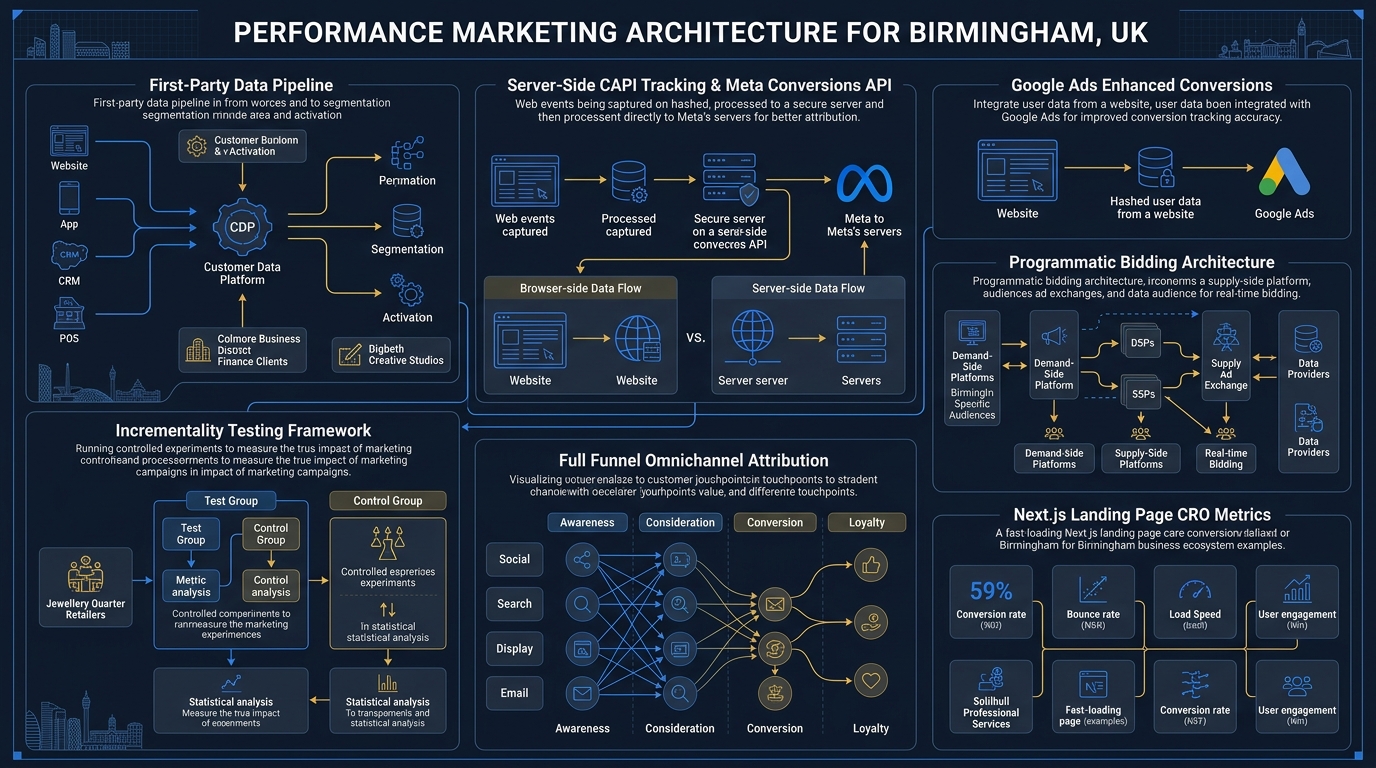
Legacy browser-based pixels suffer heavy signal loss from ad blockers, mobile tracking restrictions, and evolving cookie policies. Relying exclusively on client-side JavaScript tags obscures over thirty percent of actionable conversion signals, misinforming automated bidding algorithms and inflating acquisition costs. We eliminate this vulnerability by deploying dedicated server-side tracking containers hosted on low-latency edge infrastructure. Our telemetry pipeline captures web interactions, securely hashes user identifiers, and transmits validated events directly to Meta and Google endpoints.
Deploying edge telemetry on your enterprise root domain restores complete conversion visibility and improves customer match rates on major ad platforms. Real-time event deduplication ensures transactions, qualified lead submissions, and pipeline milestones are recorded accurately without duplicate counting. This first-party data architecture feeds pristine signals into machine learning bid algorithms, training ad platforms to prioritize high-value prospects across the West Midlands while protecting your tracking against browser privacy changes.
3. UK GDPR, ICO AdTech Governance & FCA Compliance Standards
Running enterprise paid advertising campaigns across the United Kingdom demands strict adherence to statutory privacy legislation and commercial advertising regulations. The Information Commissioner's Office rigorously enforces cookie consent requirements under PECR and UK GDPR. Furthermore, Birmingham financial institutions and corporate advisory firms across the Colmore Business District must observe Financial Conduct Authority Consumer Duty rules and ASA CAP Code directives. Regulatory compliance must serve as a core technical foundation.
Our engineering team deploys deterministic consent management systems utilizing Google Consent Mode v2 and compliant server-side filtering. When visitors decline non-essential cookies, our systems strip personal identifiers while transmitting cookieless pings for privacy-compliant conversion modeling. For regulated financial and professional services, we establish automated review frameworks ensuring mandatory risk disclosures, transparent fee representations, and accessible contractual terms remain consistent, safeguarding your enterprise against compliance risks while driving commercial growth.
| Architecture / Capability | Legacy Agency Approach | DesignNCode Engineered Growth |
|---|---|---|
| Telemetry & Conversion Tracking | Fragile browser pixels losing 35%+ of data to ad blockers | Server-side CAPI edge containers with real-time SHA-256 hashing |
| Attribution Methodology | Flawed last-click reporting inflating brand search metrics | Algorithmic multi-touch attribution & geo-matched incrementality |
| Landing Page Infrastructure | Bloated drag-and-drop builders with 4+ second load times | Sub-second React Server Components with dynamic keyword injection |
| CRM Telemetry & Bidding | Unfiltered surface leads optimized for low volume cost | Closed-loop CRM offline profit signals feeding smart value bidding |
4. Multi-Touch Attribution, Incrementality Testing & Media Mix
Last-click attribution presents an inherently distorted view of marketing effectiveness by assigning complete conversion value to the final touchpoint. This structural flaw causes marketing leaders to over-invest in branded search while neglecting top-of-funnel discovery channels that initiate buyer awareness. To establish authentic financial accountability, DesignNCode implements econometric media mix modeling paired with algorithmic multi-touch attribution. We analyze how programmatic display impressions, paid social videos, and commercial search queries interact across extended buyer journeys.
To distinguish true marketing causality from baseline organic conversions, we conduct systematic geo-matched incrementality testing across regional media markets. By evaluating conversion lift in target Birmingham test regions against matched control territories across the UK, we measure the precise incremental revenue generated by each marketing investment. This empirical approach eliminates wasted media spend, allowing executive leadership to scale profitable acquisition campaigns with statistical confidence while amplifying synergy across unified SEO services and paid channels.
Performance Marketing Architecture & Delivery Matrix: Birmingham
5. High-Velocity Next.js Landing Pages & Conversion Architecture
Even the most sophisticated media buying strategy fails when incoming paid traffic reaches sluggish, poorly structured web destinations. Every fraction of a second in page load latency creates a measurable decrease in conversion rates, eroding return on ad spend and inflating acquisition expenses. Our engineering team builds custom, edge-rendered landing page systems powered by Next.js and React Server Components. By eliminating heavy third-party scripts and optimizing assets at the edge, we achieve sub-second page loads and top-tier Core Web Vitals.
Speed operates alongside contextual relevance to maximize conversion rates. We implement dynamic server-side content personalization that automatically aligns landing page headlines, value propositions, and proof assets with incoming search keywords and ad creative parameters. Integrated with conversion-focused UI/UX design services, streamlined inquiry workflows, and instant backend CRM validation endpoints, our landing page architectures convert expensive paid traffic into qualified enterprise opportunities at significantly higher rates.
6. B2B Industrial, Professional Services & High-Ticket Lead Gen
Birmingham's manufacturing heritage and expanding corporate core generate distinct requirements for high-value business-to-business customer acquisition. Industrial equipment manufacturers, corporate legal practices, and specialist engineering consultancies cannot depend on broad consumer marketing tactics. We design sophisticated account-based marketing programs across LinkedIn Campaign Manager and B2B programmatic networks, targeting verified corporate executives, procurement leaders, and operations directors across specific West Midlands commercial hubs, business parks, and enterprise revenue tiers.
To guide prospective buyers through complex procurement cycles, we deploy progressive lead qualification funnels and value-oriented content delivery mechanisms. When high-value prospects engage with technical whitepapers or interactive evaluation tools, our backend pipelines synchronize behavioral engagement data with your sales platform. This actionable intelligence triggers personalized email nurture sequences and informs commercial sales teams, enabling your representatives to engage key decision-makers at the precise moment purchase intent reaches its peak.
7. Paid Search Domination, Google PMax & First-Party Bidding
Google Search represents the definitive channel for capturing high-intent commercial demand throughout Birmingham and the West Midlands. However, modern paid search management requires mastering machine learning bidding systems and Google Performance Max asset groups rather than manual bid adjustments. Without rigorous technical controls, automated campaigns routinely waste budget on low-intent search queries and unvetted mobile placements. DesignNCode implements strict governance protocols, combining extensive negative keyword libraries, brand exclusions, and structured audience signals.
We enhance automated bidding algorithms by feeding verified first-party customer values directly into Google Ads through offline conversion tracking. By reporting confirmed gross profit margins, closed enterprise contracts, and qualified pipeline milestones rather than simple form submissions, we instruct smart bidding systems to prioritize lucrative corporate contracts. This value-based bidding framework decreases blended acquisition costs while driving greater bottom-line profitability across competitive regional sectors and high-volume Shopify and e-commerce development operations.
8. Full-Funnel Omnichannel Scaling & Revenue Operations Integration
Sustainable commercial growth requires unifying isolated advertising channels into a synchronized, full-funnel customer acquisition engine. Managing campaigns in disconnected silos leads to inconsistent brand messaging, overlapping audience targeting, and inefficient capital allocation. Our full-funnel methodology orchestrates top-of-funnel brand discovery across YouTube and Meta video ads, mid-funnel consideration via authoritative thought leadership content, and bottom-of-funnel conversion capture through high-intent search campaigns and personalized retargeting journeys.
We connect your paid media infrastructure directly into enterprise revenue operations platforms, synchronizing advertising data with HubSpot, Salesforce, and custom reporting data warehouses. This unified telemetry stack provides leadership teams with transparent reporting covering customer acquisition cost, payback velocity, and customer lifetime value across every channel. To learn how our performance engineering architecture can accelerate your commercial growth, explore about our team, review our featured projects, or contact our engineering team for a strategic consultation.
Client Reviews: Birmingham
"DesignNCode transformed our legal practice marketing across the Colmore Business District. Deploying server-side CAPI telemetry alongside custom Next.js landing architectures reduced our cost per qualified corporate instruction by 38% while maintaining total compliance with SRA and GDPR standards."
Alistair Harrington
Senior Partner, Harrington Corporate Law (Colmore Row, Birmingham)
"Scaling our advanced engineering firm across the West Midlands required rigorous attribution rather than vanity metrics. Ankita Malik and her technical team built closed-loop CRM pipelines and value-based Google search campaigns that expanded our commercial contract pipeline by 240% in nine months."
Eleanor Radford
Commercial Director, Midland Precision Robotics (Solihull, Birmingham)
Frequently Asked Questions
Why deploy server-side CAPI tracking over standard browser pixels in Birmingham?+
Browser pixels lose over thirty percent of tracking signals due to ad blockers. Server-side CAPI routes encrypted conversion events directly from secure edge containers to Meta and Google, restoring attribution accuracy and lowering acquisition costs.
How do you ensure financial ad campaigns adhere to FCA and ASA regulations?+
We construct programmatic compliance matrices enforcing mandatory risk disclosures and transparent terms across creative variations. Automated verification pipelines ensure that advertisements for Colmore Business District financial firms maintain full alignment with FCA Consumer Duty rules.
What attribution models do you implement for complex B2B sales cycles?+
We deploy algorithmic multi-touch attribution paired with marketing mix modeling and incrementality testing. Rather than relying on simplistic last-click metrics, our models evaluate discovery touchpoints, engagement data, and offline CRM milestones to calculate channel revenue yield.
How do custom Next.js landing pages increase paid advertising return on ad spend?+
Sub-second load times achieved through React Server Components prevent visitor abandonment during paid clicks. Delivering dynamically personalized landing content mapped directly to incoming search keywords improves Quality Scores, lowers cost-per-click charges, and doubles conversion velocity.
How do you tailor performance marketing for Jewellery Quarter luxury retail brands?+
High-value luxury retail requires meticulous audience segmentation, affluent demographic layering, and refined visual storytelling. We combine targeted paid social storytelling with search capture funnels, directing qualified buyers into private showroom booking flows that preserve prestige.
How do you prevent budget waste on Google Performance Max campaigns?+
We implement granular negative keyword hierarchies, placement brand-safety exclusions, and custom asset groups segmented by intent. By transmitting verified offline CRM conversions into Google Smart Bidding algorithms, we train automated systems to pursue profitable enterprise contracts.
How do UK GDPR and PECR regulations impact paid campaign tracking?+
UK GDPR and PECR require verifiable user consent before executing tracking scripts. We build robust Google Consent Mode v2 architectures that dynamically adapt telemetry payloads based on user preferences, maintaining rigorous ICO compliance while leveraging algorithmic conversion modeling.
What is the typical deployment timeline for an enterprise paid growth engagement?+
Our technical onboarding spans two to four weeks, encompassing tracking container configuration, CRM telemetry integration, creative matrix development, and regulatory audits. Scaled media deployment and systematic bid optimization initiate in month one, followed by quarterly incrementality experiments.
Authoritative Sources & Citations
The regulatory, technological, and architectural standards referenced across this publication.
Statutory standards governing lawful cookie consent mechanisms and digital AdTech data protection.
Regulatory mandates establishing fair balance, risk disclosure, and Consumer Duty compliance in advertising.
Authoritative British advertising standards governing transparency, comparative claims, and digital substantiation.
Accessibility standards ensuring compliance with non-discrimination mandates under the Equality Act 2010.
Technical network interconnection specifications powering low-latency regional edge data routing.
